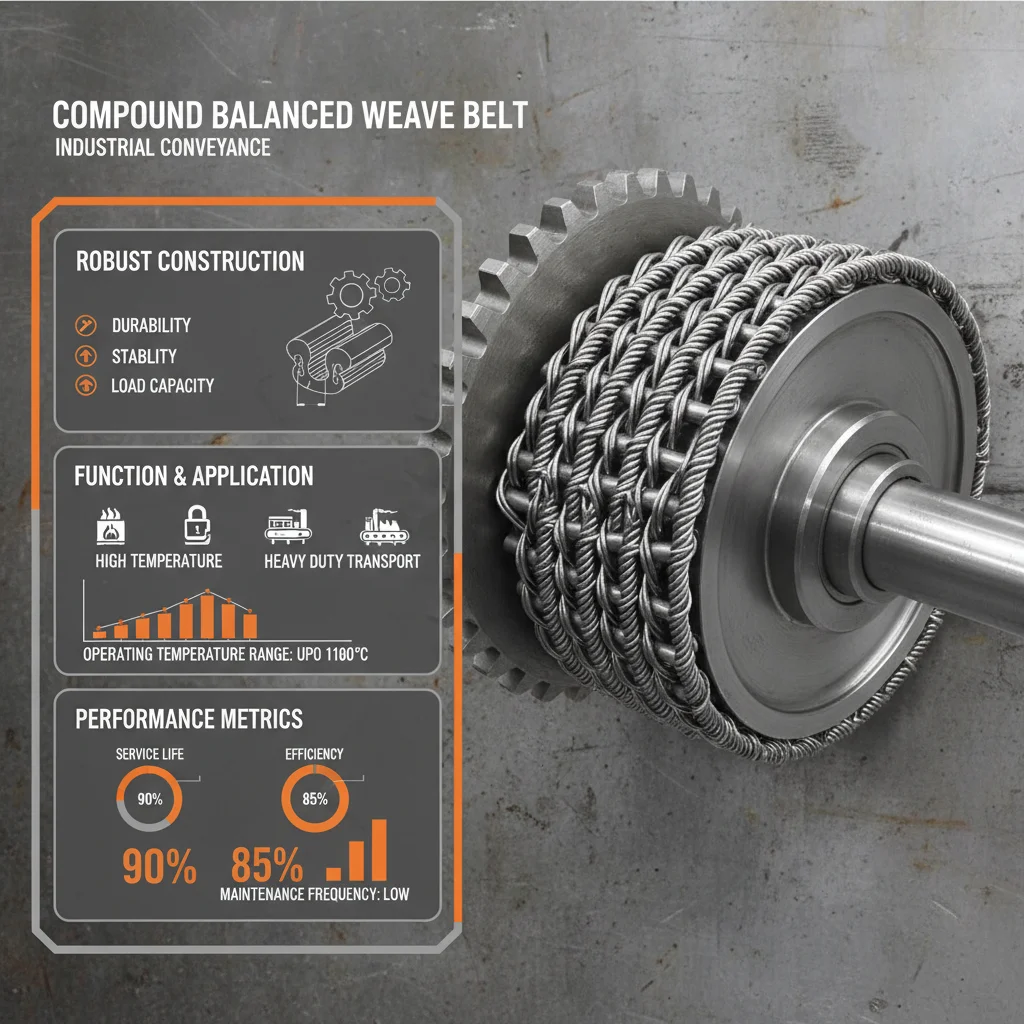
In the demanding landscape of modern industrial automation, the efficiency of material transport often determines the overall productivity of a manufacturing plant. The U-pin Joint mesh belt represents a critical evolution in conveyor technology, offering a robust solution for transporting heavy components with surgical precision. By integrating high-strength materials with a flexible joint system, these belts ensure that production lines remain fluid and resilient against the stresses of continuous operation.
Globally, the shift toward Industry 4.0 has placed an increased emphasis on durability and minimal downtime. Industries ranging from automotive assembly to food processing are facing the challenge of transporting diverse loads—from delicate electronic parts to heavy metal castings—without sacrificing speed or alignment. The adoption of advanced conveyor systems is no longer just an operational choice but a strategic necessity to maintain competitiveness in a high-output global market.
Our specialized U-pin Joint mesh belt solutions, specifically our Plate Link Conveyor Belts, address these challenges by utilizing a sophisticated hinged slat design. These belts are engineered to provide exceptional stability and strength, ensuring that whether your facility requires solid support or perforated airflow, your material flow remains seamless across every production stage.

Engineering Fundamentals of the U-pin Joint mesh belt
The engineering core of the U-pin Joint mesh belt lies in its hinged slat architecture, which transforms a series of rigid plates into a flexible, high-strength transporting surface. This design is specifically crafted to eliminate the slippage common in traditional fabric or rubber belts, providing a locked-in movement that is essential for high-precision positioning in automated assembly lines.
By utilizing heavy-duty industrial construction, these belts can withstand extreme loads while maintaining a consistent profile. The integration of cotter pins or washers for chain fixation ensures that the structural integrity is maintained even under high stress, making it an ideal choice for environments where failure is not an option.
Global Industrial Relevance and Demand
On a global scale, the demand for specialized conveying solutions has surged as manufacturing hubs in Asia, Europe, and North America push for higher throughput. The U-pin Joint mesh belt has become a cornerstone in these regions due to its ability to operate in challenging environments, including those with extreme temperatures or corrosive chemical exposure, which often render standard belts useless.
Standardization through ISO and other international quality benchmarks has pushed manufacturers to seek belts that offer both longevity and ease of replacement. The industry is moving away from "disposable" conveyor components toward modular systems that can be repaired on-site, significantly reducing the carbon footprint associated with replacing entire conveyor runs.
The primary challenge addressed by this technology is the balance between load-bearing capacity and operational agility. In high-speed pharmaceutical or automotive lines, the ability to maintain a steady flow of heavy materials without mechanical drift is the difference between a profitable shift and a costly line stoppage.
Defining the Plate Link Structural Design
At its simplest, the U-pin Joint mesh belt is a modular transport system consisting of interlocking metal plates. These plates are connected via a hinge mechanism that allows the belt to wrap around drive sprockets and return rollers with minimal friction and maximum stability.
The versatility of the U-pin Joint mesh belt is further enhanced by the option of solid or perforated configurations. Solid plates provide maximum surface area for supporting heavy, irregular items, while perforated plates are essential for applications requiring drainage, airflow for cooling, or cleaning in food-grade environments.
Modern industry relies on these structural nuances to optimize specific processes. For example, in a chemical plant, a perforated U-pin Joint mesh belt allows for the continuous rinsing of components while they move through the production line, combining transport and processing into a single step.
Core Performance Metrics and Stability
When evaluating conveyor performance, stability and maintenance speed are the two most critical KPIs. The hinged slat design ensures high-precision positioning, which is vital for automated sorting and packaging where a deviation of even a few millimeters can cause a system crash.
Compared to standard belts, the modular nature of this system allows for rapid part replacement. Because the chains are fixed with cotter pins or washers, a technician can remove a single damaged slat without dismantling the entire conveyor, reducing downtime from hours to minutes.
Performance Comparison of U-pin Joint mesh belt Variations
Multi-Industry Application Scenarios
The application scope of these belts is vast, spanning from high-hygiene food processing to heavy-duty automotive assembly. In food grade processing, specifically baking and meat processing, the perforated plates allow for precise temperature control and efficient washing and peeling of vegetables.
In the automotive and electronics sectors, the focus shifts to strength and precision. High-strength belts handle heavy automobile parts on assembly lines, while in electronic assembly, the stable conveying speed is essential for the testing and packaging of delicate components where any vibration could lead to product damage.
Long-Term Maintenance and Operational Value
Investing in a high-quality modular belt system provides a significant return on investment through an extended operational lifecycle. Unlike traditional belts that stretch or fray over time, the metallic construction of the plate link system resists wear and maintains its geometry under constant load.
The emotional value for plant managers lies in the reliability and trust these systems instill. Knowing that the conveyor will not slip during a critical production run reduces operational stress and allows the team to focus on quality control rather than emergency repairs.
Furthermore, the ease of maintenance—specifically the use of cotter pins for rapid slat replacement—means that the belt can be updated or modified as production needs change, without requiring a full system overhaul.
Customization and Future Engineering Trends
The future of material transport is moving toward bespoke engineering. We offer customizable height and thickness options, allowing the U-pin Joint mesh belt to be perfectly tailored to the specific load requirements and machinery dimensions of any given facility.
Innovation is also focusing on material science, with the introduction of advanced coatings and alloys that enhance corrosion resistance for the chemical and pharmaceutical industries. These advancements ensure that continuous material transport remains stable even when exposed to harsh reagents.
As automation increases, we are seeing a trend toward integrating these belts with smart sensors for real-time wear monitoring, further reducing unplanned downtime and moving toward a predictive maintenance model.
Core Comparison of Plate Link Conveyor Belt Configurations
| Configuration Type |
Primary Advantage |
Industry Fit |
Maintenance Grade |
| Solid Plate |
Maximum Load Support |
Automotive / Heavy Parts |
Easy (Cotter Pin) |
| Perforated Plate |
Airflow & Drainage |
Food / Pharma |
Very Easy |
| Heavy-Duty Grade |
Extreme Durability |
Chemical Logistics |
Moderate |
| Custom Height |
Machinery Alignment |
Bespoke Industrial |
Easy |
| Custom Thickness |
Load Optimization |
Electronics Assembly |
Easy |
| Wash-down Grade |
Corrosion Resistance |
Meat Processing |
Very Easy |
FAQS
Solid plates provide maximum surface support for heavy items, ensuring no sagging under high weight. Perforated plates, conversely, allow for airflow, drainage, or cleaning, making them ideal for food washing or chemical processes where liquid removal is necessary during transport.
Our belts are designed for rapid maintenance. The chains are fixed with cotter pins or washers, allowing technicians to remove and replace individual slats or damaged components quickly without dismantling the entire conveyor system, which drastically reduces production downtime.
Yes, we provide comprehensive customization regarding plate height, material thickness, and perforation patterns to ensure the belt meets the specific regulatory (such as FDA for food) and technical standards required by your industry.
They are highly beneficial for the Food industry (baking, meat processing), Pharmaceuticals (tablet packaging), Chemical industry (continuous transport), and Automotive assembly lines where stability and heavy-duty strength are paramount.
The combination of a stable hinged slat structure and high-quality side chains ensures a consistent conveying speed and prevents slippage. This mechanical lock provides the precision needed for automated sorting and packaging lines.
Yes, our belts are constructed for heavy-duty use. Depending on the chosen material and finish (such as stainless steel), they are designed to maintain stability and efficiency even in the demanding conditions of the chemical industry.
Conclusion
The U-pin Joint mesh belt, specifically in its Plate Link configuration, offers an unparalleled blend of strength, precision, and maintainability. By replacing traditional belt systems with a hinged slat design, manufacturers can achieve higher operational stability, reduced downtime through rapid part replacement, and the versatility to handle everything from food-grade processing to heavy automotive assembly.
As industrial requirements evolve toward greater automation and sustainability, investing in customizable, heavy-duty conveying solutions is the most effective way to future-proof your production line. We encourage you to evaluate your current transport bottlenecks and consider how a tailored modular system can optimize your throughput. Visit our website for more information: www.jymeshbelt.com