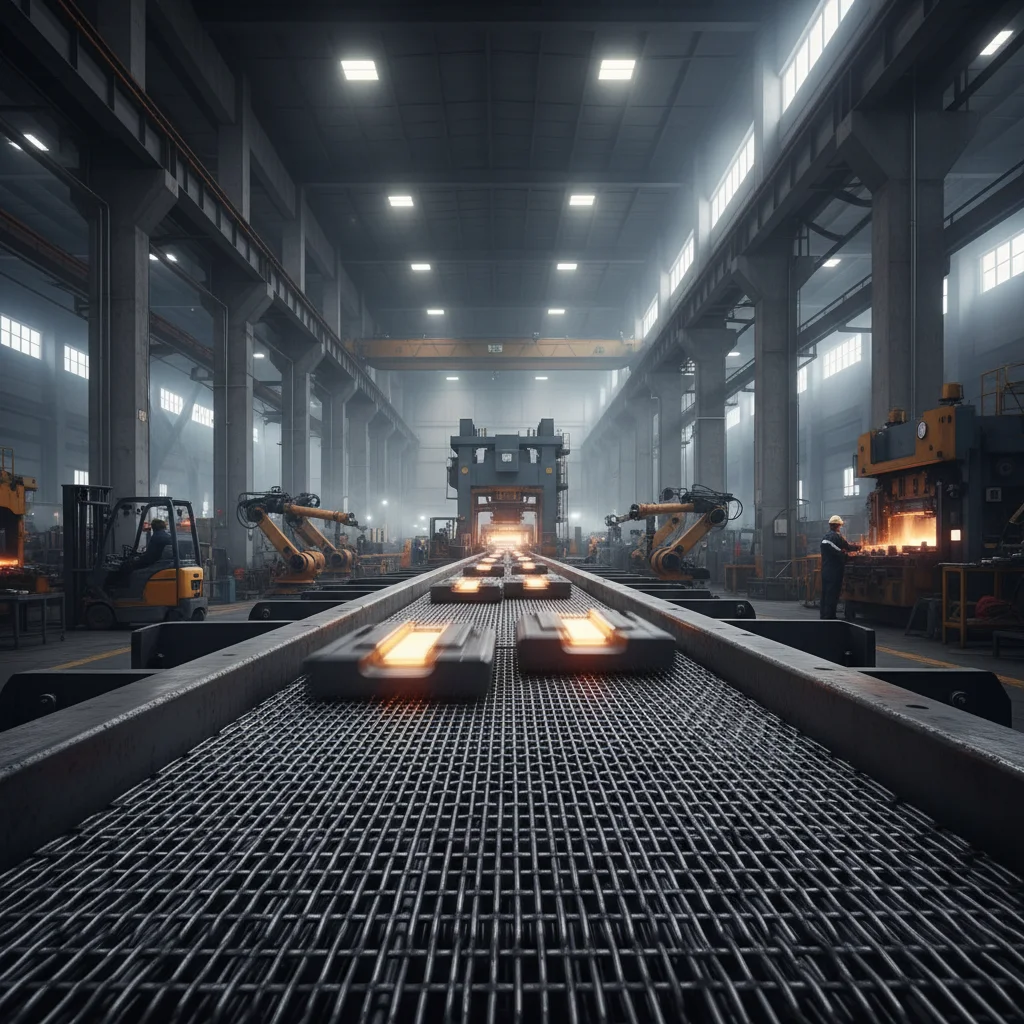
In the modern landscape of industrial automation, the efficiency of material handling often determines the overall productivity of a production line. The wavy threading mesh belt emerges as a sophisticated engineering solution designed to bridge the gap between stability and flexibility, ensuring that delicate or heavy-duty components are transported with minimal friction. By integrating a unique undulating weave pattern, these belts provide superior grip and airflow, making them indispensable in high-precision manufacturing environments.
Globally, the demand for advanced conveyor systems is surging as industries shift toward "Industry 4.0" standards, where synchronization and reliability are paramount. The implementation of a wavy threading mesh belt allows operators to handle complex geometries and thermal fluctuations that would typically cause standard flat belts to slip or deform. This adaptability is not just a technical advantage but a commercial necessity for companies aiming to reduce downtime and operational waste.
Understanding the nuances of this technology—from its metallurgical composition to its threading architecture—empowers engineers to optimize their workflows. Whether it is used in food processing, automotive assembly, or electronics cooling, the wavy threading mesh belt provides a balanced approach to load distribution and durability, ensuring a longer lifecycle for the entire conveyor system.

Global Industrial Context of Wavy Threading Mesh Belts
On a global scale, the precision of mechanical transmission components is governed by strict ISO standards to ensure interoperability and safety. The wavy threading mesh belt has become a focal point for industries striving to meet these standards while increasing throughput. In regions like East Asia and Europe, where high-density manufacturing is prevalent, the ability of these belts to resist thermal expansion and maintain structural integrity under load is critical for maintaining 24/7 operation cycles.
The primary challenge addressed by this technology is the "slippage-deformation" paradox, where traditional belts either grip too tightly (causing wear) or too loosely (causing misalignment). By utilizing a wavy threading architecture, manufacturers can achieve a natural "spring" effect that absorbs vibrations and distributes weight more evenly across the belt's surface, significantly reducing the energy required for drive components to move heavy loads.
Defining the Mechanics of Wavy Threading Mesh Belts
A wavy threading mesh belt is a specialized industrial conveyor belt characterized by a non-linear, undulating weave of metallic wires. Unlike standard flat mesh, the "wavy" aspect refers to the geometric configuration of the transverse threads, which creates a series of controlled peaks and valleys across the belt's width. This design is specifically engineered to increase the surface contact area with the product being transported, enhancing stability without sacrificing the belt's ability to breathe or drain.
From a mechanical perspective, this structure acts as a flexible lattice. When a load is placed upon it, the wavy threads distribute the pressure dynamically, preventing the "bottoming out" effect common in thinner mesh belts. This makes it an ideal choice for industries dealing with irregular shapes or fragile materials that require a cushioned yet secure transit through heating or cooling tunnels.
In the context of humanitarian and large-scale industrial needs, such as automated food distribution or pharmaceutical packaging, the wavy threading ensures that hygiene is maintained. The open-mesh nature allows for high-pressure cleaning and air circulation, which is vital for meeting FDA or similar health regulations globally, ensuring that the belts do not become breeding grounds for contaminants.
Core Components and Engineering Factors
The durability of a wavy threading mesh belt is primarily rooted in its material selection. Most high-performance versions utilize 304 or 316L stainless steel, ensuring maximum resistance to oxidation and chemical corrosion. The tensile strength of the longitudinal wires must be perfectly balanced with the flexibility of the wavy transverse threads to prevent stretching over time.
Scalability is another critical factor; the wavy threading mesh belt can be customized in width and pitch to fit various conveyor frames. The "pitch" refers to the distance between the waves, and adjusting this allows engineers to fine-tune the belt for either maximum airflow (wider pitch) or maximum support (tighter pitch), depending on the product's density.
Cost efficiency is realized through the reduction of maintenance intervals. Because the wavy design reduces friction and wear on the drive sprockets, the overall "Total Cost of Ownership" (TCO) is significantly lower than that of standard belts. This efficiency makes it a preferred choice for high-volume production lines where a single hour of downtime can cost thousands of dollars.
Practical Performance Metrics in Modern Applications
Evaluating the performance of a wavy threading mesh belt requires looking at specific KPIs such as load-bearing capacity, thermal resistance, and friction coefficients. In comparative tests, the wavy threading design consistently outperforms flat weaves in terms of longitudinal stability, especially when transporting items that are prone to shifting.
Moreover, the integration of these belts into automated systems allows for precise tracking. Because the wavy patterns provide consistent "anchor points" for sensors, the belt can be integrated into smart factory systems that track individual items in real-time, ensuring a seamless transition between different stages of the manufacturing process.
Performance Comparison of Wavy Threading Mesh Belt Variants
Global Applications and Diverse Use Cases
The versatility of the wavy threading mesh belt is evident in its widespread use across diverse sectors. In the food industry, particularly in commercial baking and frying, these belts are essential for ensuring uniform heat distribution. The wavy pattern allows hot air to circulate beneath the food, preventing "cold spots" and ensuring a consistent finish across the entire batch.
Beyond food, the automotive and aerospace industries utilize these belts for the transport of precision-machined parts through chemical baths or curing ovens. In remote industrial zones, where maintenance resources are scarce, the inherent reliability of the wavy threading design reduces the frequency of emergency repairs, providing peace of mind to facility managers operating in challenging environments.
Long-Term Value and Sustainable Advantages
Investing in a wavy threading mesh belt offers a compelling logical and emotional value proposition. Logically, the reduction in energy consumption—due to lower friction—directly lowers operational costs. Emotionally, the increased safety and reliability of the system foster trust among the workforce, as the risk of belt failure and subsequent industrial accidents is significantly minimized.
From a sustainability perspective, the longevity of stainless steel mesh means fewer replacements and less landfill waste compared to rubber or PVC belts. This aligns with global corporate social responsibility (CSR) goals, allowing companies to market their production processes as "green" and environmentally conscious, which is increasingly important to modern consumers and stakeholders.
Furthermore, the adaptability of these belts means they can be refurbished rather than replaced. By adjusting the tension and cleaning the weave, a wavy threading mesh belt can often be extended beyond its expected lifecycle, providing long-term value that far exceeds the initial capital expenditure.
Future Innovations in Mesh Belt Technology
The future of the wavy threading mesh belt lies in the integration of "smart materials" and digital twins. We are seeing a trend toward the use of nano-coatings that further reduce friction and increase antimicrobial properties, which will be revolutionary for the pharmaceutical and biotech industries.
Automation is also playing a huge role; new AI-driven monitoring systems can now detect microscopic wear in the wavy threads before a failure occurs. By using acoustic sensors, the system can alert operators to a specific section of the belt that requires attention, shifting the maintenance model from "reactive" to "predictive."
As we move toward a more sustainable future, we expect to see the emergence of recycled high-grade alloys that maintain the structural integrity of the wavy weave while reducing the carbon footprint of the manufacturing process. This evolution will ensure that mesh belt technology remains at the forefront of industrial efficiency.
Comparative Analysis of Wavy Threading Mesh Belt Material & Design Options
| Material Grade |
Wave Pitch Density |
Thermal Stability |
Wear Resistance |
| SS 304 Standard |
Medium |
High |
7/10 |
| SS 316L Marine |
High |
Ultra-High |
9/10 |
| Nickel-Alloy |
Low |
Extreme |
10/10 |
| Coated Carbon Steel |
Medium |
Medium |
6/10 |
| Teflon-Infused SS |
High |
High |
8/10 |
| Titanium Blend |
Custom |
Ultra-High |
9/10 |
FAQS
The primary advantage is the undulating surface, which increases the contact area and provides a natural "grip" on products. This prevents items from sliding during acceleration or deceleration, while simultaneously allowing for better airflow and drainage than a flat surface, making it superior for heating and cooling processes.
When constructed from high-grade stainless steel (like SS 316L), these belts can last several years even in extreme temperatures. The key to longevity is the wavy design, which distributes thermal expansion more evenly, reducing the risk of warping or snapping compared to rigid conveyor options.
Yes, they are designed to be highly compatible. However, it is recommended to check the sprocket pitch and width. Because the wavy threads create a specific profile, ensuring that your drive components are matched to the belt's specific threading geometry will maximize efficiency and reduce wear.
Absolutely. The wavy structure acts as a micro-cushion, reducing the impact of vibration on delicate components. Many electronics manufacturers use them in soldering or cooling phases to ensure that parts remain stable without being subjected to the harsh pressures of a solid belt.
Due to the open-mesh design, these belts are ideal for Clean-In-Place (CIP) systems. High-pressure water jets and food-grade detergents can pass through the weave, removing debris from both the top and bottom. Regular inspections of the "valleys" in the wave are recommended to ensure no buildup occurs.
The initial investment is higher due to the cost of stainless steel and the complex weaving process. However, the long-term value is far greater because they do not degrade under heat, require less frequent replacement, and significantly lower the cost of energy and maintenance over the system's life.
Conclusion
In summary, the wavy threading mesh belt represents a pinnacle of mechanical transmission engineering, combining the strength of industrial metals with a geometry that optimizes grip, airflow, and durability. By addressing the critical needs of modern manufacturing—specifically the requirement for stability under extreme conditions—this technology provides a sustainable and efficient path toward higher production yields and lower operational risks.
Looking forward, as industries continue to embrace automation and green energy, the role of specialized conveyor components will only grow. We suggest that facility managers evaluate their current belt wear-and-tear patterns and consider upgrading to a wavy threading system to future-proof their operations. For more information on high-performance conveyor solutions, visit our website: www.jymeshbelt.com.