- Tel: +86 15252586600 / +86 13705250816
- Email: 527966138@qq.com / 1026520412@qq.com
Maintaining the delicate texture of raw fish while ensuring high-throughput processing is a primary challenge in modern seafood industrialization. The choice of conveyor material directly impacts food safety, product integrity, and the overall hygiene of the processing environment.
In the specific context of sushi and sashimi production, where precision cutting and temperature control are critical, the conveyor system must offer more than just transport. It must facilitate rapid drainage, withstand rigorous sanitization cycles, and prevent the marking of sensitive protein surfaces.
Selecting the right Sushi and sashimi production lines mesh belt requires an understanding of the intersection between mechanical durability and food-grade compliance to ensure an efficient, contaminant-free workflow.


In sashimi production, the primary risk factor is bacterial growth facilitated by residual moisture and protein buildup. Standard solid belts often create "dead zones" where organic matter can trap and decay, leading to cross-contamination.
Metal mesh belts address this by providing a high-porosity surface. This allows water, brine, and blood to drain instantly during the transport phase, ensuring that the fish is moved through the production line without sitting in stagnant fluids.
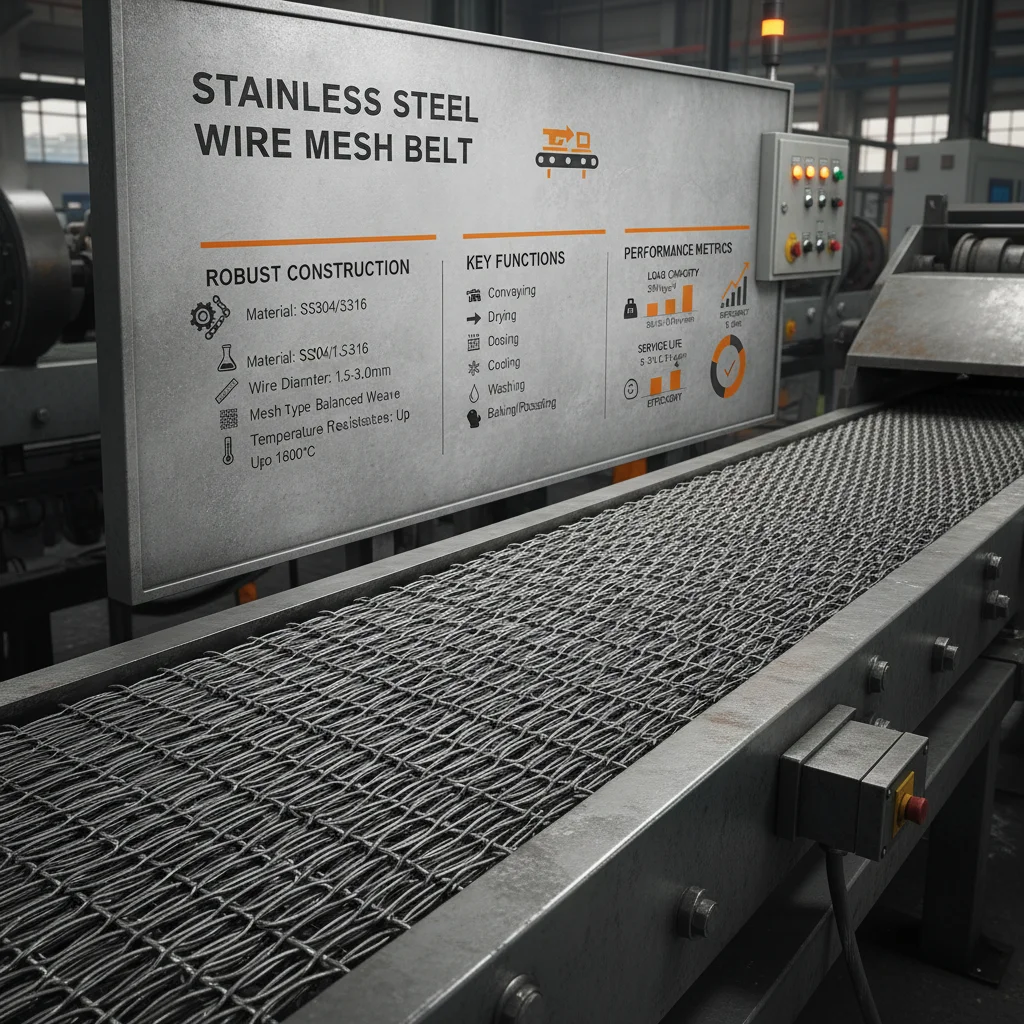
The mechanical design of a sushi production line mesh belt focuses on tension stability and surface smoothness. Unlike industrial kiln belts, food-grade belts must be engineered to eliminate any burrs or sharp edges that could tear the delicate flesh of a tuna or salmon fillet. This requires precision weaving or CNC-guided assembly to ensure a seamless transit surface.
From a structural standpoint, the belts are often categorized by their weave density. A tighter weave provides better support for smaller sushi rice portions, while a more open mesh is preferred for sashimi fillets to maximize airflow and drainage. The integration of drive components must be perfectly synchronized to prevent jerky movements that could displace the precise arrangement of the fish.
Furthermore, the dimensional stability of the belt is paramount. Any lateral drift or "wandering" of the belt across the conveyor frame can cause product misalignment, which is particularly problematic in automated slicing stations where millimeter-precision is required for consistent piece thickness.
The chemical environment of a seafood plant is aggressive, characterized by high humidity, salt exposure, and the use of strong alkaline cleaners. Choosing a material that does not react with these agents is the first step in ensuring long-term equipment reliability.
The use of high-grade stainless steel is non-negotiable in sashimi lines because it prevents oxidation and resists pitting corrosion caused by saltwater, thereby eliminating the risk of metallic flakes contaminating the food.
While some industrial sectors use galvanized steel, the food industry relies almost exclusively on austenitic stainless steels (such as 304 or 316). These alloys provide the necessary corrosion resistance and are naturally biocompatible, meeting the stringent requirements of global food safety certifications.
Evaluating the efficiency of a mesh belt system involves analyzing several qualitative and quantitative indices. The most critical are the drainage rate, surface friction (to prevent product slippage), and the ease of sterilization. A belt that is difficult to clean increases the "down-time" required for sanitation, reducing the overall daily output.
When comparing different mesh configurations, manufacturers often use a relative value index to determine which design best suits a specific part of the production line—such as the initial washing stage versus the final plating stage.
The integration of a mesh belt into a sashimi line must account for the "CIP" (Clean-In-Place) process. Because metal belts are open-structured, they allow high-pressure water jets and sanitizing foams to penetrate the entire conveyor width and reach the underlying support plates, which is nearly impossible with traditional rubber belts.
For a manufacturer evaluating their line, the focus should be on the transition points between different belt sections. Smooth transitions prevent the "pinching" of fillets, which can lead to product waste and potential points of bacterial accumulation. Proper tensioning systems are essential to maintain this flow throughout the 24-hour production cycle.
Historically, seafood processing relied on manual transport or basic plastic belts. However, the shift toward "industrialized sashimi" has necessitated a transition to high-precision metal belts. The move is driven by the need for tighter temperature control; metal belts allow cold air to circulate around the product from both above and below, maintaining the "cold chain" even during movement.
Recent trends show an increase in the use of hybrid drive components that reduce vibration. Since the precision of the cut is everything in sushi, any micro-vibration in the conveyor belt can lead to uneven slices. The development of stabilized flat-wire constructions has significantly reduced this mechanical noise.
As automation increases, we are seeing the rise of belts that can integrate with sensors for real-time product tracking. This allows the production line to adjust the speed of the mesh belt based on the thickness of the fish being processed, optimizing both quality and output.
When selecting a conveyor system, the trade-off usually lies between support surface area and drainage capability. A belt with too much open space may cause small pieces of sushi rice to fall through, while a belt that is too dense may trap moisture.
The decision framework should be based on the specific stage of the production line. For instance, the raw fish washing stage requires maximum drainage, whereas the final packaging stage requires a more stable, flat surface to prevent the product from shifting during the sealing process.
By analyzing these operational variables, companies can customize their belt configurations to match their specific throughput and hygiene requirements.
| Production Stage | Key Requirement | Recommended Mesh Type | Relative Suitability |
|---|---|---|---|
| Initial Washing | High Drainage | Open Spiral Mesh | Excellent |
| Brine Soaking | Corrosion Resistance | 316 Stainless Steel | Essential |
| Precision Slicing | Zero Vibration | Rod-Reinforced Flat | High |
| Quality Inspection | Visual Contrast | Polished Fine Mesh | Moderate |
| Cold Storage Transit | Air Circulation | High-Porosity Mesh | Excellent |
| Final Plating | Surface Stability | Dense Flat Wire | High |
Metal mesh belts, particularly those made of stainless steel, offer superior heat conductivity and drainage. In sashimi production, maintaining a low temperature is critical to prevent spoilage. Metal belts allow cold air to penetrate the product from all sides. Additionally, they can withstand the aggressive high-temperature chemical washes required for sterilization, which would degrade most plastic polymers over time.
Marking is prevented through a combination of material polishing and precise weaving. By using a high-degree polish on the stainless steel wires and ensuring there are no burrs or irregular weld points, the belt surface becomes smooth. Additionally, selecting a mesh density that provides adequate support for the fillet's weight prevents the fish from sagging into the gaps, which is the primary cause of marking.
The most effective method is a combined CIP (Clean-In-Place) approach using high-pressure heated water jets and alkaline foaming agents. Because the belt is a mesh, the cleaners can reach both the top and bottom surfaces simultaneously. Periodic deep cleaning with a specialized brush is recommended to remove any protein buildup in the intersections of the wire weave to ensure 100% hygiene.
Yes, customization is standard. Manufacturers can adjust the wire diameter, the spiral pitch, and the overall mesh density. For example, a line producing small nigiri sushi requires a denser mesh to support the rice, whereas a line for large sashimi slabs can utilize a more open weave to prioritize drainage and airflow. Widths and edge treatments are also tailored to the specific conveyor frame.
While high-grade stainless steel belts have a higher initial purchase price than plastic or galvanized options, they significantly lower the total cost of ownership. This is due to their extreme durability and resistance to corrosion. They require fewer replacements and reduce the risk of costly product recalls caused by contamination, making them a more economical long-term investment for high-volume producers.
The primary risks are chemical contamination and physical hazards. Non-food-grade belts may contain lubricants or alloys that leach into the fish. Furthermore, they lack the surface smoothness required for food safety, meaning they can trap bacteria in microscopic pits or shed metallic particles into the product, leading to severe regulatory violations and health risks for the end consumer.
The efficiency of a sushi and sashimi production line is fundamentally tied to the quality of its transport system. By prioritizing stainless steel mesh belts, manufacturers can simultaneously solve the problems of drainage, temperature control, and hygiene.
As the industry moves toward greater automation and stricter food safety mandates, the shift toward high-precision, food-grade conveyor components is no longer optional—it is a prerequisite for operational success and consumer trust.