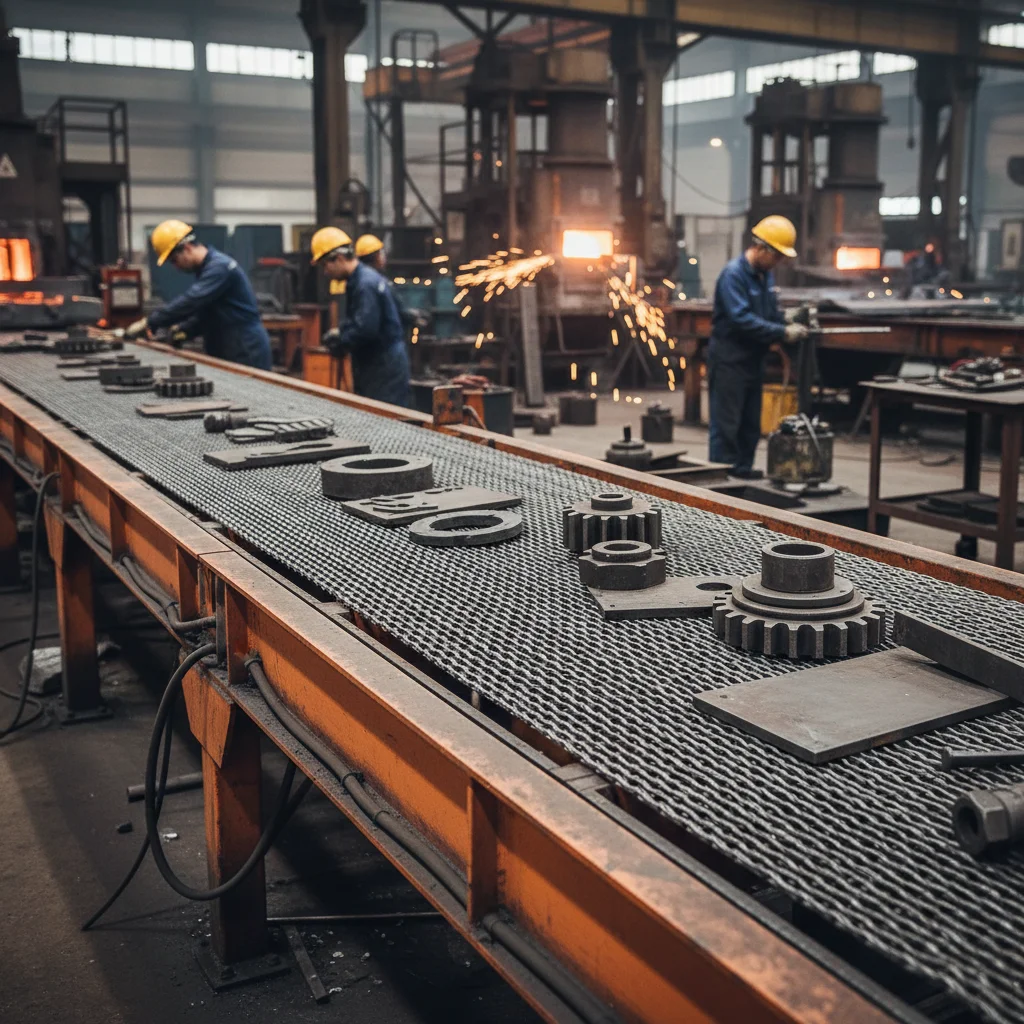
In the demanding environment of high-temperature industrial processing, the selection of a reliable transport system is critical for maintaining throughput and product quality. The Tunnel-Type Copper Brazing Furnace mesh belt represents a sophisticated engineering solution designed to move components through rigorous thermal cycles without compromising structural integrity. By integrating high-strength metal flat wires into a stable honeycomb configuration, these belts ensure that heat distribution remains uniform and movement stays consistent.
Globally, the precision of brazing and heat treatment processes directly impacts the reliability of automotive and electronic components. The challenge lies in finding a conveyor medium that can withstand intense heat while resisting mechanical deformation over thousands of operating hours. This is where the specialized design of a Tunnel-Type Copper Brazing Furnace mesh belt becomes indispensable, bridging the gap between raw industrial power and precise thermal control.
Understanding the material science and structural engineering behind these belts allows manufacturers to optimize their production lines for maximum efficiency. From the selection of 316 stainless steel for acid resistance to the implementation of custom lock edges for stability, every detail is engineered for endurance. This guide explores how the Tunnel-Type Copper Brazing Furnace mesh belt serves as the backbone for modern heat treatment and brazing operations.

Structural Engineering of the Mesh Belt
The structural integrity of a Tunnel-Type Copper Brazing Furnace mesh belt is rooted in its honeycomb-like architecture. Constructed from a combination of support shafts and precision-cut metal sheets, the belt utilizes a welding process at both ends of the support shafts to create a rigid yet flexible matrix. This ensures that the belt can navigate the curves of a tunnel furnace without sagging or twisting, maintaining a flat profile for the products being transported.
To further enhance stability, these belts can be customized with lock edges, edge baffles, and transverse baffles. These additions prevent the lateral shifting of parts during high-speed transit and provide extra reinforcement against the thermal expansion and contraction cycles typical of copper brazing environments. The result is a highly stable operation that minimizes downtime and reduces the risk of product misalignment.
Material Selection for High-Temperature Environments
Choosing the right material for a Tunnel-Type Copper Brazing Furnace mesh belt is a balance between cost-efficiency and environmental resistance. For general-purpose applications where costs are a primary concern, carbon steel serves as an economical foundation. However, for environments exposed to moisture or mild corrosive agents, galvanized steel is preferred due to its enhanced corrosion resistance, which extends the lifespan of the belt in humid furnace entry and exit zones.
In more aggressive industrial settings, such as those involving chemical coatings or food-grade requirements, 304 stainless steel is the industry standard. Its inherent resistance to oxidation and chemicals makes it ideal for sterilization lines and pharmaceutical drying. For the most extreme conditions—specifically those involving saltwater or high-acid concentrations—316 stainless steel is employed, providing superior longevity and preventing the structural degradation that can lead to belt failure.
The versatility of these material options ensures that whether the furnace is used for automotive parts heat treatment or building material drying, the conveyor system remains resilient. By matching the metal grade to the specific chemical and thermal profile of the brazing process, operators can significantly reduce the frequency of belt replacements and ensure a more sustainable production cycle.
Precision Design and Mesh Configuration
The efficiency of heat transfer in a brazing furnace is heavily dependent on the openness of the conveyor. A Tunnel-Type Copper Brazing Furnace mesh belt is engineered with regular rectangular or square mesh holes, which allows for the maximum flow of heated air or gases around the workpiece. This uniform structure prevents "cold spots" and ensures that every component receives an equal amount of thermal energy.
Customization is key to the performance of the Tunnel-Type Copper Brazing Furnace mesh belt. Depending on the size and weight of the brazed parts, the mesh density and opening size can be adjusted. This precision prevents smaller components from falling through the belt while maintaining enough porosity to avoid obstructing the furnace's internal convection currents.
Furthermore, the ability to specify custom widths and lengths means the Tunnel-Type Copper Brazing Furnace mesh belt can be integrated into existing furnace architectures without requiring extensive modifications to the drive components. This adaptability reduces installation time and ensures a seamless fit between the conveyor and the furnace rollers.
Performance Metrics in Industrial Brazing
Evaluating the performance of a conveyor system requires a look at several key metrics: stability, heat resistance, and durability. In the context of a Tunnel-Type Copper Brazing Furnace mesh belt, stability is measured by the belt's ability to track straight over long distances without drifting. When combined with high-grade stainless steel, these belts maintain their tension and shape even when subjected to continuous thermal cycling.
The operational efficiency is often compared across different configurations to determine which setup yields the lowest maintenance cost per thousand hours of operation. By analyzing the wear rates of various material grades, facilities can make informed decisions on whether the initial investment in 316 stainless steel is justified by the reduction in replacement cycles.
Material Performance Comparison for Tunnel-Type Copper Brazing Furnace mesh belt
Global Application Scenarios
The application of the Tunnel-Type Copper Brazing Furnace mesh belt extends far beyond simple heat treatment. In the automotive industry, these belts are critical for the production of radiators and heat exchangers, where components must move through precise temperature zones to ensure strong brazed joints. Similarly, in the electronics sector, they are used for the curing of specialized coatings and the sintering of ceramic components.
Beyond heavy industry, the food processing and pharmaceutical sectors utilize the same honeycomb structure for cooling, drying, and sterilization. Whether it is drying gypsum boards in the building materials industry or sterilizing medical instruments, the stability and hygiene provided by stainless steel mesh belts make them a global standard for continuous-flow production.
Long-Term Value and Operational Reliability
The long-term value of investing in a high-quality Tunnel-Type Copper Brazing Furnace mesh belt is realized through the reduction of unplanned downtime. A belt that resists warping and corrosion prevents the "snagging" that often causes emergency furnace shutdowns. By ensuring a smooth, continuous flow of materials, manufacturers can maximize their OEE (Overall Equipment Effectiveness) and maintain a predictable production schedule.
From a logical perspective, the reliability of the belt directly correlates with product yield. In brazing, any vibration or shifting of the part can lead to a defective joint, resulting in costly scrap. The stable operation of the honeycomb structure ensures that parts remain stationary relative to the belt, guaranteeing consistent results across every batch.
Emotionally, the peace of mind provided by using E-E-A-T compliant manufacturing standards allows plant managers to focus on scaling production rather than troubleshooting conveyor failures. Trust in the material's ability to withstand extreme heat translates to a more confident approach to innovation and process optimization within the facility.
Future Trends in Conveyor Technology
As industry 4.0 continues to evolve, the Tunnel-Type Copper Brazing Furnace mesh belt is being integrated with smart monitoring systems. Future iterations are likely to include embedded sensors that can detect belt tension and wear in real-time, allowing for predictive maintenance rather than reactive repairs. This digital transformation will further reduce waste and optimize energy consumption within the furnace.
Sustainability is also driving the development of new alloys that offer higher heat resistance with lower environmental footprints during production. There is a growing trend toward "green" heat treatment, where conveyor belts are designed to minimize heat loss, thereby reducing the carbon footprint of the entire brazing operation.
Automation is playing a pivotal role as well, with robotic loading and unloading systems becoming more synchronized with the belt's speed. The Tunnel-Type Copper Brazing Furnace mesh belt will continue to adapt, moving toward a modular design that allows for quicker section replacements, ensuring that the production line never truly stops.
Comparative Analysis of Mesh Belt Materials and Applications
| Material Type |
Corrosion Resistance |
Thermal Stability |
Primary Industry |
| Carbon Steel |
Low |
Moderate |
General Manufacturing |
| Galvanized Steel |
Moderate |
Moderate |
Building Materials |
| 304 Stainless |
High |
High |
Food & Pharma |
| 316 Stainless |
Very High |
Very High |
Chemical Processing |
| Custom Alloy |
Variable |
Extreme |
Aerospace/Auto |
| Nickel-Plated |
High |
High |
Precision Brazing |
FAQS
The honeycomb structure provides superior stability and uniform air distribution. Unlike standard belts, the welded support shafts and regular rectangular openings prevent sagging under heavy loads and ensure that heat reaches all surfaces of the part equally, which is essential for quality brazing.
Choose 304 stainless steel for general corrosion resistance and food-grade applications. However, if your brazing process involves high salinity, strong acids, or highly corrosive chemical coatings, 316 stainless steel is necessary as it contains molybdenum, which provides superior resistance to pitting and chloride corrosion.
Yes, they can be fully customized. You can specify the mesh hole size (rectangular or square) to ensure parts do not fall through, and you can request custom widths and lengths to fit your specific tunnel furnace dimensions. We also offer optional lock edges and baffles to keep parts securely in place.
Replacement intervals vary by material and load. Carbon steel may require more frequent changes, whereas 316 stainless steel can last for years. We recommend monthly inspections for tension and wear. Replacing the belt before it develops structural warps prevents costly production halts.
Lock edges provide additional structural rigidity to the belt's sides, preventing it from fraying or shifting on the rollers. Baffles (edge and transverse) act as guards, ensuring that parts remain aligned in their specific lanes and do not collide or shift during transport through the furnace.
Absolutely. Our metal flat wire belts are designed to work seamlessly with standard industrial drive components. Because of their uniform structure and stable operation, they provide a consistent speed that is easily synchronized with PLC-controlled automated loading and unloading systems.
Conclusion
The implementation of a high-quality Tunnel-Type Copper Brazing Furnace mesh belt is more than just a hardware choice; it is a strategic decision that impacts the entire production chain. By combining a stable honeycomb structure with precision-engineered materials like 316 stainless steel, manufacturers can ensure uniform heat distribution, minimize product defects, and drastically reduce operational downtime. The synergy between material durability and structural stability forms the foundation of a reliable heat treatment process.
Looking forward, the integration of smart monitoring and sustainable alloys will continue to redefine the efficiency of industrial conveyors. We suggest that operators regularly evaluate their material choices against their specific chemical environment to maximize the lifespan of their equipment. To explore the best conveyor solutions for your specific furnace needs, visit our website: www.jymeshbelt.com.